
Most small businesses in the UAE start with an accounting package, a few spreadsheets and a lot of WhatsApp messages. That works for a while. Then the business grows: more customers, more stock, more staff, a second location. Suddenly the owner is spending evenings reconciling numbers that never quite agree.
This is the point where an ERP system stops being a "big company" tool and becomes essential. This guide explains why an ERP system is important, what ERP software for small businesses in the UAE should include, and how to choose and roll one out without disrupting daily work.
What is an ERP system?
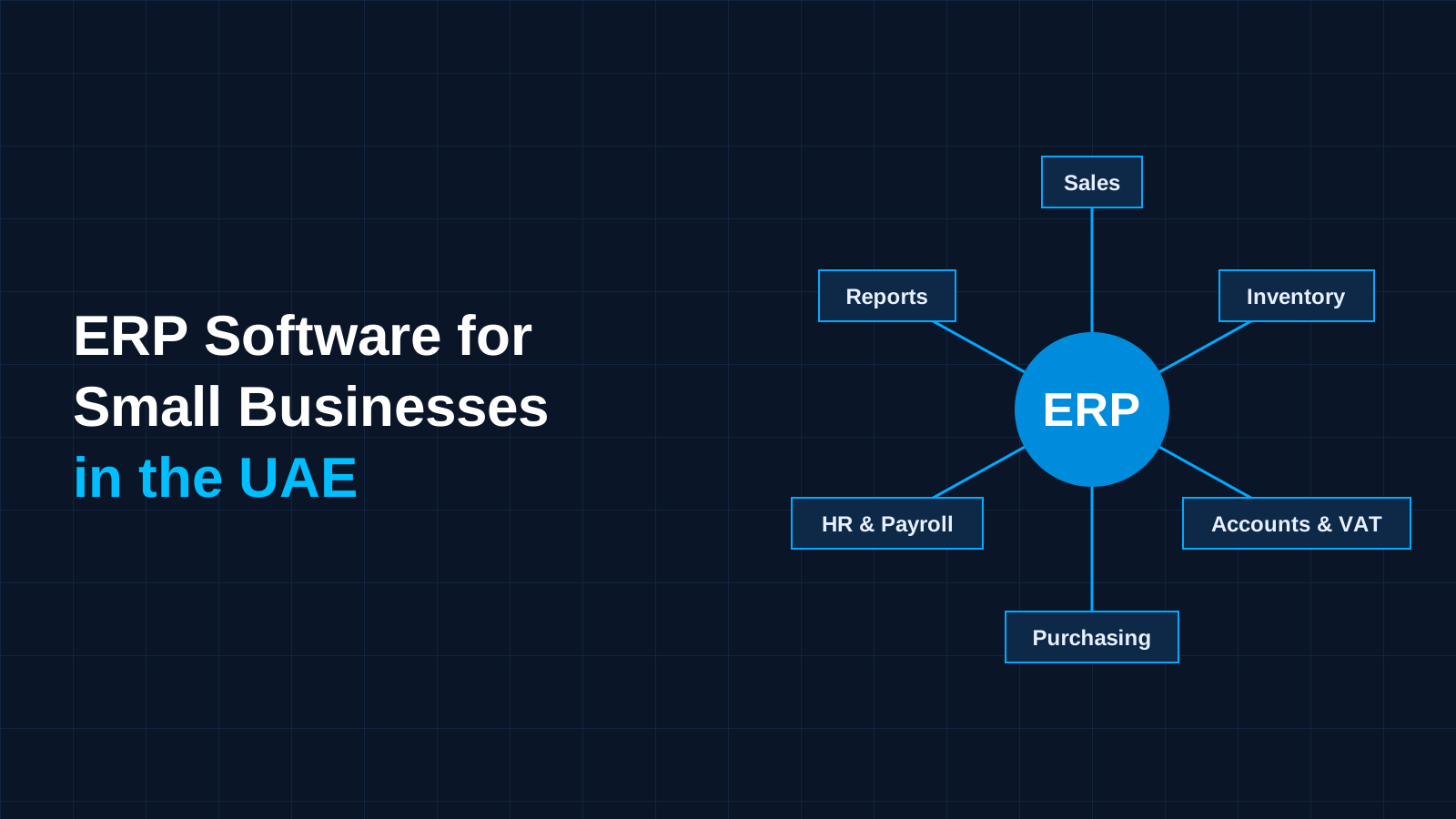
ERP stands for enterprise resource planning. In simple terms, an ERP system is one piece of software that runs the core of your business from a single database: sales, purchasing, inventory, accounting, payroll, projects and reporting.
The key word is one. When a salesperson creates an order, the warehouse sees it, stock is reserved, the invoice is generated from the same data and the accounts are updated automatically. Nobody re-types anything.
Why an ERP system is important for small businesses
1. One source of truth
With separate tools, every department has its own version of the numbers. An ERP system gives everyone the same live data, so sales, operations and finance stop arguing about whose spreadsheet is right.
2. Less manual work and fewer errors
Every time data is copied from one system to another, mistakes creep in: a wrong price, a missed discount, an invoice sent twice. ERP removes most double entry, which frees your team for work that actually grows the business.
3. Control over stock and cash
For trading, retail and distribution businesses, stock is usually the largest asset on the balance sheet. ERP tracks quantities and costs by location in real time, warns you before you run out and shows slow-moving items. On the finance side, you can see receivables, payables and cash position at any moment instead of at month-end.
4. UAE tax and compliance built in
UAE businesses deal with 5% VAT and corporate tax at 9% on taxable income above AED 375,000. Both depend on clean, complete records. A good ERP applies the right VAT treatment on every transaction, keeps an audit trail and makes returns faster to prepare.
E-invoicing is the next step. Under the UAE mandate, businesses with revenue below AED 50 million must appoint an accredited service provider by 31 March 2027 and go live on 1 July 2027. Your invoicing system needs to produce structured e-invoices and connect to that provider. Read our guide to UAE e-invoicing deadlines and phases for the full timeline.
5. Better decisions, faster
When all your data lives in one place, reports and dashboards update themselves. You can see which products, customers or projects make money, and which do not, without waiting for someone to build a spreadsheet.
6. Room to grow
A cloud ERP lets you add users, modules, branches and companies as you grow. You do not need to change systems every time the business doubles in size.
Signs your business has outgrown spreadsheets
| Area | Warning sign |
|---|---|
| Month-end | Closing the books takes days of reconciling spreadsheets |
| Stock | System stock rarely matches what is on the shelf |
| Double entry | Orders and invoices are typed into more than one system |
| Reporting | Owners wait for someone to build a report by hand |
| Cash | Nobody can say quickly who owes you and how much |
| Compliance | VAT returns and audits mean a scramble for documents |
If two or more of these sound familiar, it is time to look at ERP.
What ERP software for small businesses in the UAE should include
- Accounting with UAE VAT: tax codes, VAT returns support, multi-currency and bank reconciliation.
- Sales and CRM: quotations, orders, invoicing and customer history in one place.
- Purchasing and inventory: purchase orders, multiple warehouses, batch or serial tracking and landed cost where you import goods.
- HR and payroll: employee records, leave and payroll that can produce Wages Protection System (WPS) files.
- E-invoicing readiness: a clear path to PINT AE e-invoices through an accredited service provider.
- Cloud and mobile access: so owners and field teams can work from anywhere.
- Industry fit: features for how you actually work, for example trading and distribution, fit-out and interior projects, facility management or manpower supply.
Zoho or Odoo for a small business?
Two ERP platforms are especially popular with UAE small and medium businesses, and NVS Technologies implements both:
- Zoho (Zoho Books, Inventory, CRM, People and Creator) suits businesses that want quick, affordable cloud apps that work well together. Zoho Books also supports UAE e-invoicing. See Zoho ERP implementation in Dubai.
- Odoo suits businesses that want one integrated platform with deeper manufacturing, inventory or project features and more room for customisation. See Odoo ERP implementation in the UAE.
The right choice depends on your processes, not on brand names. A short discovery workshop usually makes the decision clear.
How to roll out ERP without disrupting your business
- Map your processes first. Write down how orders, purchases, stock and month-end work today, and where they break.
- Start with the core. Go live with finance, sales and inventory first. Add HR, projects or service modules once the team is comfortable.
- Clean your data. Customers with valid TRNs, suppliers, items and opening balances need to be right before go-live.
- Test with real transactions. Run a normal week of orders, invoices and payments in a test environment.
- Train the people who use it every day. Short, role-based training beats one long session for everyone.
- Review after 30 days. Fix the small issues early, before workarounds become habits.
How NVS Technologies helps
NVS Technologies is a Dubai-based ERP implementation partner for Zoho and Odoo, working with small and growing businesses across the UAE. We help you choose the right platform, configure it for UAE VAT and e-invoicing, migrate your data, train your team and support you after go-live.
Explore our ERP software services in Dubai and e-invoicing software for UAE businesses, or get a quote for a free ERP consultation.